

Virtual reality is no longer the preserve of video games or experimental technology demonstrations. With increasingly available hardware and more sophisticated software, a variety of industries find immersive tools to solve real business and production challenges.
Among the most far-reaching changes is how digital assets are being created and used. Through 3D modeling in virtual reality, companies are moving away from screen-based design to spatial, hands-on creation that improves accuracy, speed, and collaboration.
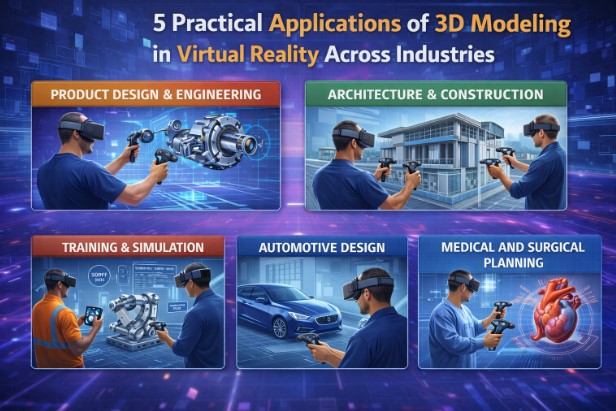
Five pragmatic, present uses of the technology that would make a difference include the following:
1. Product Design & Prototyping
Probably one of the most immediate beneficiaries of VR-based modeling would be product design. The traditional workflow commonly involves designers who have to imagine scale and form on flat displays, which can often result in late-stage changes whenever products are finally reviewed in real size.
Designers can conceptualize and evaluate at a real scale from the very beginning in fully immersive Virtual Environments. One is able to walk around a model, view details from all sides, and manipulate them with gestures rather than abstract controls.
This approach allows teams to:
- Recognize proportion problems early
- Validating Ergonomics & Usability
- Reduce reliance on physical prototypes
2. Architecture, Construction, and Spatial Planning
That is a very important understanding of space in view of architecture and construction. Very few detailed drawings or 3D renderings give one that actual feeling one has from a space.
This will finally allow architects and planners to design within immersive environments in which scale, depth, and circulation are immediately clear, and walls, ceilings, furniture, and fixtures may be judged as if existing.
In this regard, 3D modeling in Virtual Reality supports:
- More accurate space planning
- Early Detection of Layout Issues
- Improve communication with clients and stakeholders
Directly experiencing spaces means that clients, who perhaps struggle to interpret plans or renderings, may result in faster approvals and fewer late-stage design changes.
3. Industrial Training and Simulation
Most such industries have complex machinery, equipment, or environments that are too expensive or dangerous to access for training purposes. VR modeling makes it possible to create realistic training assets without physical risk.
Virtual clones of equipment or installations are modeled and placed into immersion training scenarios. The trainees interact with the equipment as they would in real life, learning procedures firsthand rather than through instruction alone.
This tool is particularly helpful for:
- Heavy Industries and Manufacturing
- Energy & Utilities
- Aerospace and Defense
Training is more engaging, safer, and easier to scale while organisations minimize downtime and reduce operational risk.
4. Entertainment, Media, and Experience Design
But for many internal production workflows, the immersive creation is being taken well beyond just end-user experiences in the entertainment industry. Film, animation, and game studios increasingly use VR to block out scenes, environments, and characters.
Creation of assets by artists in immersive space:
- Design Environments at Cinematic Scale
- Experiment with composition & movement
- Make creative decisions faster while in the early stages
Instead of having to imagine how a scene will feel once it’s built, creators experience it firsthand. This leads to much more solid artistic direction and far more cohesive final outputs.
VR modeling pays off particularly in pre-production, where velocity and flexibility are required.
5. Collaborative Design & Remote Reviews
Creation today is distributed across teams, locations, and time zones. Screenshots or video calls that review digital assets cause delays in feedback and lead to misunderstandings.
VR makes it possible to have a co-review of assets by allowing multiple participants to be immersed in the same virtual space to review the assets. This allows designers and engineers to indicate, gesticulate, and discuss changes standing inside the model in real time.
This approach:
- Improves clarity during reviews.
- Reduces misunderstanding of feedback.
- Speeds up approval cycles.
As collaborations increasingly go remote, immersive review workflows pose more natural and effective alternatives to traditional review methods.
Why These Apps Deliver Real Value
Instead of replacing traditional tools, VR extends existing workflows by strengthening the very first and most creative parts of production.
Integrating VR into Existing Pipelines
Let me first put on record that VR modeling does not exist in a vacuum; whatever is created within those immersive environments usually finds its way to production pipelines for refinement and optimization in order to serve.
Most organizations deploy VR for:
- Early Concept Development
- Peer review
Final detailing still requires established tools and experience, as well as technical optimization and integration. The hybrid approach gives creative freedom without sacrificing quality in production.
The Role of Professional Expertise
While immersive creation tools make it even more intuitive to create, one nonetheless needs to possess the technical acumen in order to create assets that are both usable and of high quality. Topology, performance, and compatibility need to be thoughtfully managed.
That is where the value of experienced 3D modeling services comes in to bridge the gap between experimental workflows and production standards, making sure that assets created inside VR environments are up to production standards in the real world.
Preparing for the Future of Digital Workflows
Creation in VR today is a niche capability that will grow to be normal for many industries as VR continues its maturation into more robust immersive technologies. Early-adopting organizations develop experience, hone processes, and build confidence in spatial creation.
This training positions teams better for their adaptation once immersive platforms become more integrated into everyday production.
Conclusion
It is already yielding practical benefits in everything from product design and architecture through to training, entertainment, and collaboration. By allowing creatives to work directly within their designs, 3D modeling in VR will increase spatial accuracy, accelerate iteration, and enhance communication. Coupled with established production pipelines and technical know-how, VR-based modeling has fast become a strong tool to solve real-world challenges and shape the future of digital asset creation.